Bologna, 2 August 1980: the events and the memory
Updated on 20 July 2026 From Federico Farinelli

Updated on 20 July 2026 From Federico Farinelli
Outside Bologna Centrale station, visible from the square in front of it, there is a clock at the very top of the building that has stopped. It always reads 10.25.
Why has it stopped at that time? What happened on 2 August 1980 at that very moment, and why do those hands remain frozen there to remind us of it?
A bomb exploded in the station’s second-class waiting room. From that day onwards, 2 August 1980 will be remembered as the day of the Bologna massacre.
| Date | 2 August 1980 |
|---|---|
| Time | 10.25 |
| Location | Bologna Centrale station |
| Site of the explosion | Second-class waiting room |
| Casualties | 85 dead |
| Injured | 200 |
| Memorials | Clock, memorial plaque, gap in the wall, bus number 37 |
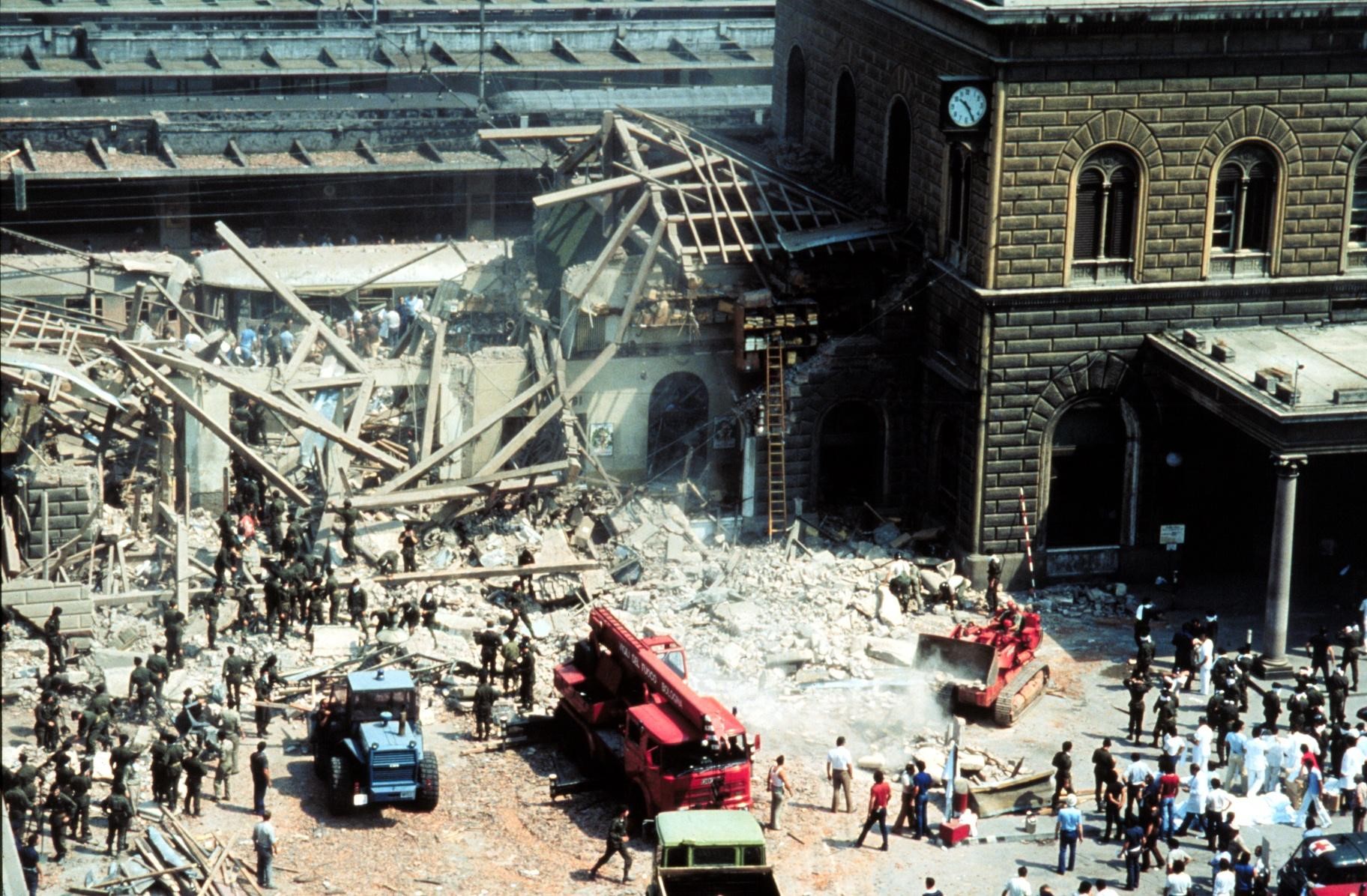
On Saturday 2 August 1980, at 10.25 am, a bomb exploded in the second-class waiting room at the station. The blast affected the surrounding areas, caused part of the building to collapse and also struck platform one.
The station was crowded with people travelling for the summer holidays. Among those present were families, workers, students and travellers from various Italian cities and other countries.
The attack killed 85 people and injured 200. It is the massacre with the highest number of victims to have occurred in Italy during the years of the ‘strategy of tension’.
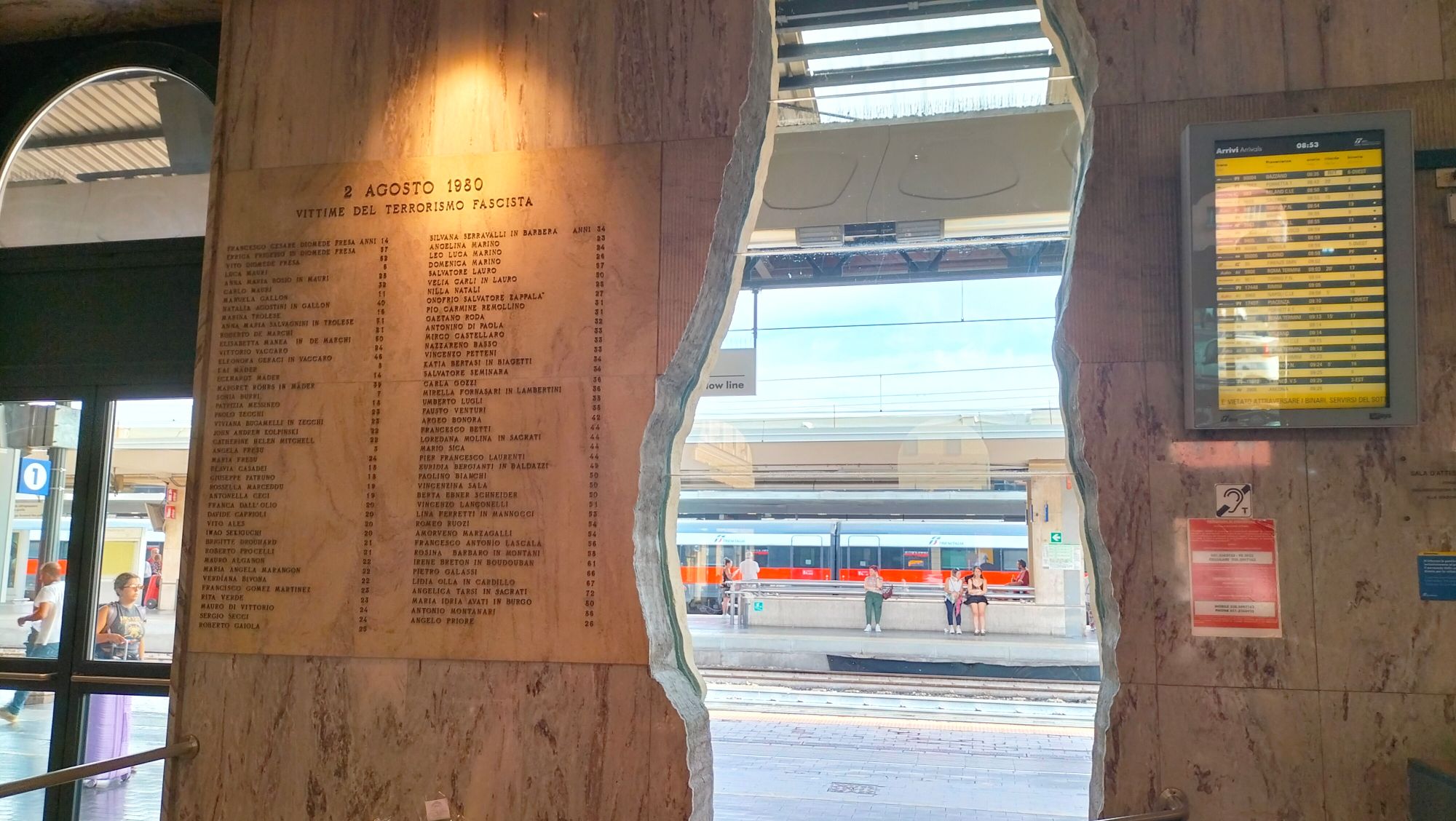
The bomb left a physical gash in the building. During the reconstruction, part of the wall was preserved as a memorial. Anyone passing through the station today can still see that spot and read the names engraved on the memorial plaque.
The figure 85 represents people of different ages, with different stories and destinations. The youngest victim, Angela Fresu, was 3 years old. Many people were either setting off on holiday or returning to their families.
The Association of Relatives of the Victims of the Bologna Station Bombing of 2 August 1980 maintains on its website the names and biographies of the victims. Reading them gives each person a face and a story, beyond mere statistics.
Rescue efforts began immediately. Firefighters, medical staff, law enforcement officers, railway workers, taxi drivers, bus drivers and members of the public rushed to the station. There were not enough ambulances available.
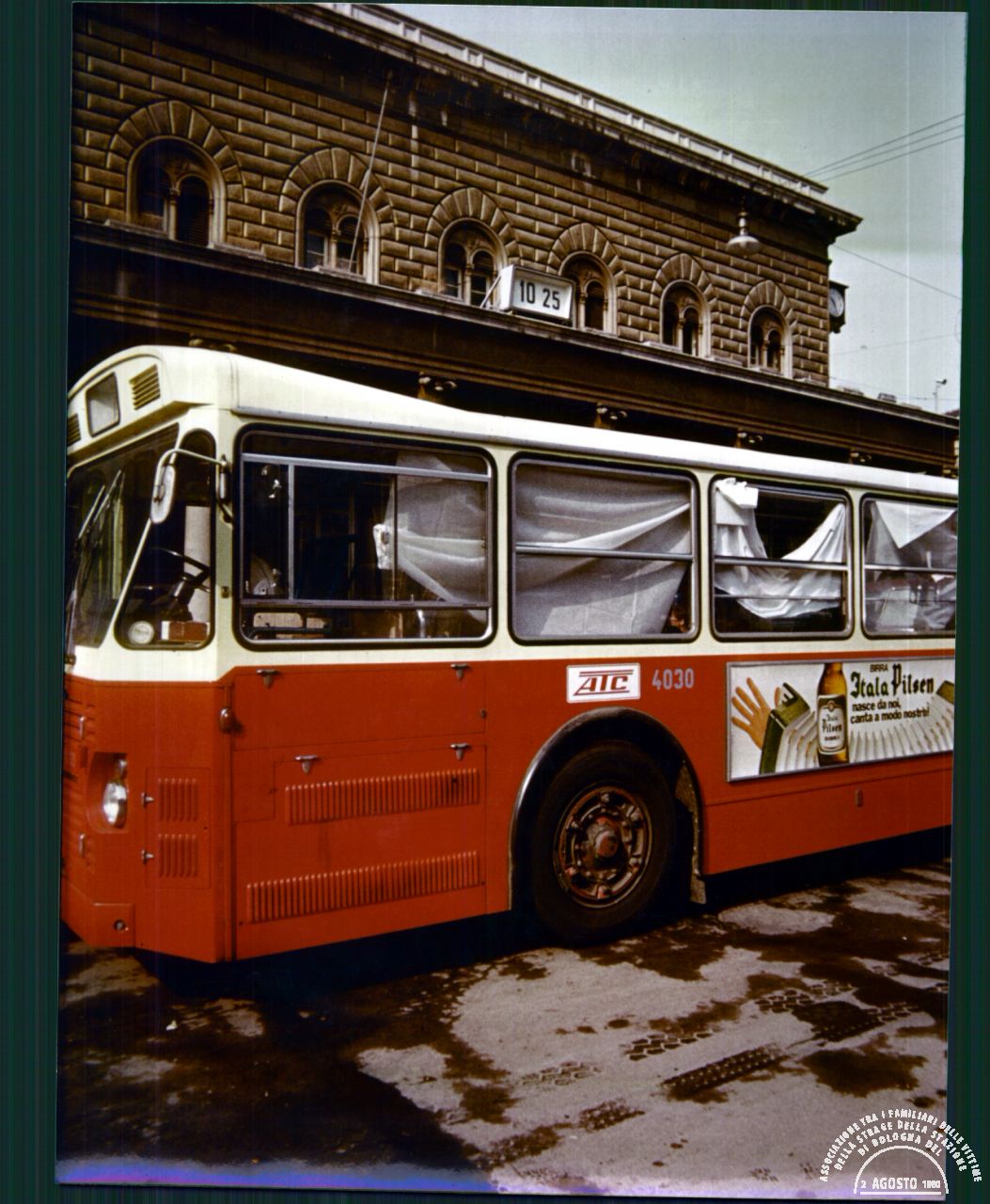
A bus from route 37 was used to transport the bodies from the rubble to the mortuary. This is why it has become one of the best-known symbols of that day.
Other buses, taxis and private cars took the injured to hospitals. The response was organised within minutes, whilst the city was still trying to understand what had happened.
The account of the rescue efforts holds a special place in the memory of Bologna. It tells of people who acted together in an extreme situation, using whatever was at their disposal.
The Bologna massacre took place during the years of the ‘strategy of tension’, marked by terrorism, political violence, clandestine organisations and attempts to influence Italian democratic life.
The final judgements established the neo-fascist origins of the attack. Valerio Fioravanti, Francesca Mambro, Luigi Ciavardini and Gilberto Cavallini were definitively convicted for their involvement in the massacre.
On 1 July 2025, the Court of Cassation also made final the life sentence imposed on Paolo Bellini. The grounds for the judgement confirmed his deliberate involvement in the attack and the role attributed to him in transporting the explosives.
During the various proceedings, convictions were also handed down for attempts to mislead the investigation. The lengthy judicial process has distinguished the responsibilities of the perpetrators from those relating to the planning, financing and obstruction of the investigations.
The matter is complex and continues to require precise clarification. To piece together the names, roles and levels of the courts involved, it is advisable to consult the judgements, the judicial archives and the documentation held by the Association of Relatives.
Every year, Bologna commemorates the 85 victims and their families. At 10.25 am, the time of the explosion, the city observes a minute of silence in front of the station.
The commemoration brings together public remembrance and the quest for justice . The victims’ names are read out so that the story is not reduced to a date or a number.
The commemoration also concerns the defence of democratic institutions. The trials took decades, whilst the victims’ families attended hearings, gathered documents and demanded that those responsible be held to account.
The Association of Victims’ Families was founded on 1 June 1981. Its statutory aim was to secure the justice due through every possible means.
2 August is also the day on which Bologna commemorates the rescue workers. The damaged station, bus 37 and the silence at 10.25 are all part of the city’s collective memory.
Anyone entering the station may come across various reminders of the massacre.
The clock on the façade shows the time of the explosion. It is one of the most immediate symbols of 2 August 1980.
For years it remained stopped. After some technical work, it temporarily started working again, but was then reset to 10.25 to preserve its role as a memorial.
Inside the station is a memorial plaque dedicated to the 85 victims. The names are listed together, without any hierarchy.
It takes just a few minutes to read them. It is the simplest way to realise that behind the word ‘massacre’ there are real people.
A section of the masonry damaged by the explosion has been preserved. The reconstruction has not entirely erased the building’s scar.
The wall allows the station space to be read as a historical record. It should be viewed with discretion, without obstructing the passage of passengers.
On Platform 1, a plaque marks the spot struck by the explosion. The Ancona–Chiasso train, which was stationary at the time, also suffered the effects of the blast.
The memorials are situated within a station that is still in use. There is no admission fee and no booking is required. What is required is respect for the people, for the names and for those who pass through these spaces every day.
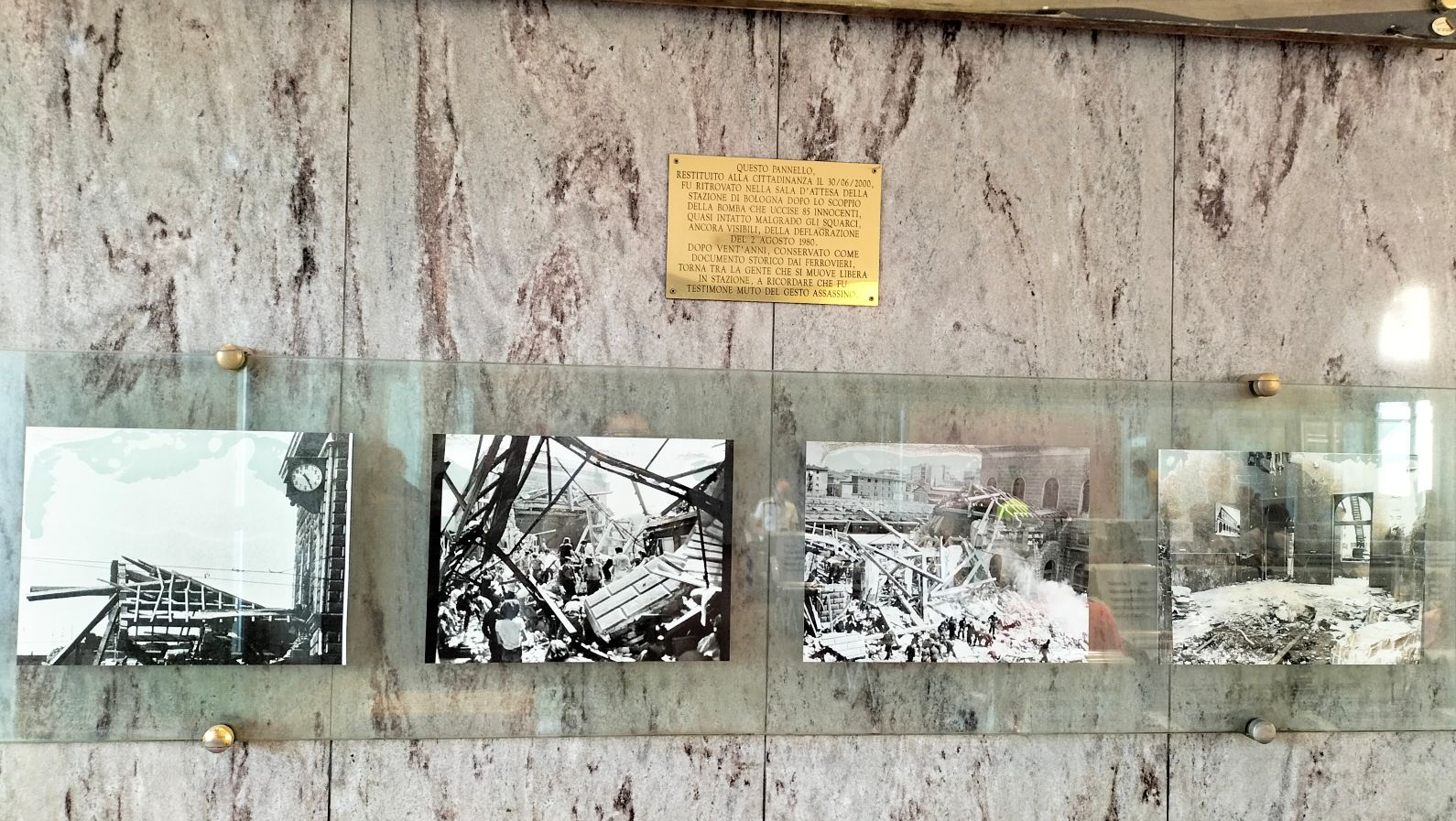
On the morning of 2 August, a city-wide procession takes place, heading towards the station. The programme usually includes a gathering with the families of the victims, official speeches and a moment of silence at 10.25 am.
The route, timetable and events change every year. Before taking part, it is advisable to check the updated page on Events for the 2 August commemoration .
In the evening, Piazza Maggiore traditionally hosts the closing concert of the ‘2 August’ International Composition Competition. The works are performed in memory of the victims.
Throughout the day, there may be exhibitions, talks, film screenings, and running and cycling relays. The annual programme is published by the Municipality of Bologna, the Association of Relatives and the organisations involved.
To find out more about the victims’ biographies, the trial documents and the history of the Association, please visit the official website Bologna 2 August 1980 .
The ‘Monuments to Remembrance’ section of Bologna Welcome lists other sites linked to the civic history of Bologna and the metropolitan area.
These include the Shoah Memorial , near the station, and the Marzabotto Memorial, in the Bolognese Apennines. Each site holds a different story and requires time, attention and specific sources.
The 2 August route ends in front of Bologna Central Station. Here, at 10.25 am, the city comes to a standstill. The clock continues to show the time when Bologna was struck and began to come to the rescue.
At 10.25 am, a bomb exploded in the second-class waiting room at Bologna Centrale station. The explosion caused part of the building to collapse, killing 85 people and injuring 200. Court rulings have established that the attack was carried out by neo-fascists.
10.25 am is the time the bomb exploded on 2 August 1980. The clock on the station’s façade is kept at that time as a public memorial to the 85 victims.
During the rescue operations, the number 37 bus was used to transport the bodies recovered from the rubble to the mortuary. The bus has become a symbol of the immediate response by bus drivers, paramedics, firefighters and members of the public.
The final convictions for complicity in the bombing concern Valerio Fioravanti, Francesca Mambro, Luigi Ciavardini, Gilberto Cavallini and Paolo Bellini. Bellini’s life sentence became final on 1 July 2025. Other proceedings have concerned cover-ups and further levels of responsibility.