Bologna explained by its geology
Updated on 13 June 2026 From Karoline Villacidro

Geology isn’t just found in books or museums. You can actually touch it.
It emerges in the milky reflections of selenite, in the red of the bricks, in the stones of the towers and in the subsoil of Bologna, extending out to the outskirts of the city where the landscape reveals its living matter.
Read this guide to Bologna’s geological sites and discover places where you can admire the materials and walk along the roughest paths amongst gypsum, selenite and other historic rocks.
The place to go is Sala Borsa, at number 3 in Piazza del Nettuno.
Beneath the glass floor, you can catch a glimpse of the archaeological excavations of ancient Bononia, with its road networks, the foundations of public buildings and the ancient Roman civil basilica, but traces of later periods are also visible, such as some medieval foundations and the remains of Ulisse Aldrovandi’s Botanical Garden.
Bologna’s subsoil becomes an initial mental map: clay and silt in the historic centre, sand and gravel towards the areas marked by the Reno and Savena rivers.
A visit to the Sala Borsa excavations is possible for a
voluntary donation during the times indicated on the official website. It is a short stop, perfect for
embarking on a geological tour of Bologna without leaving the city centre.
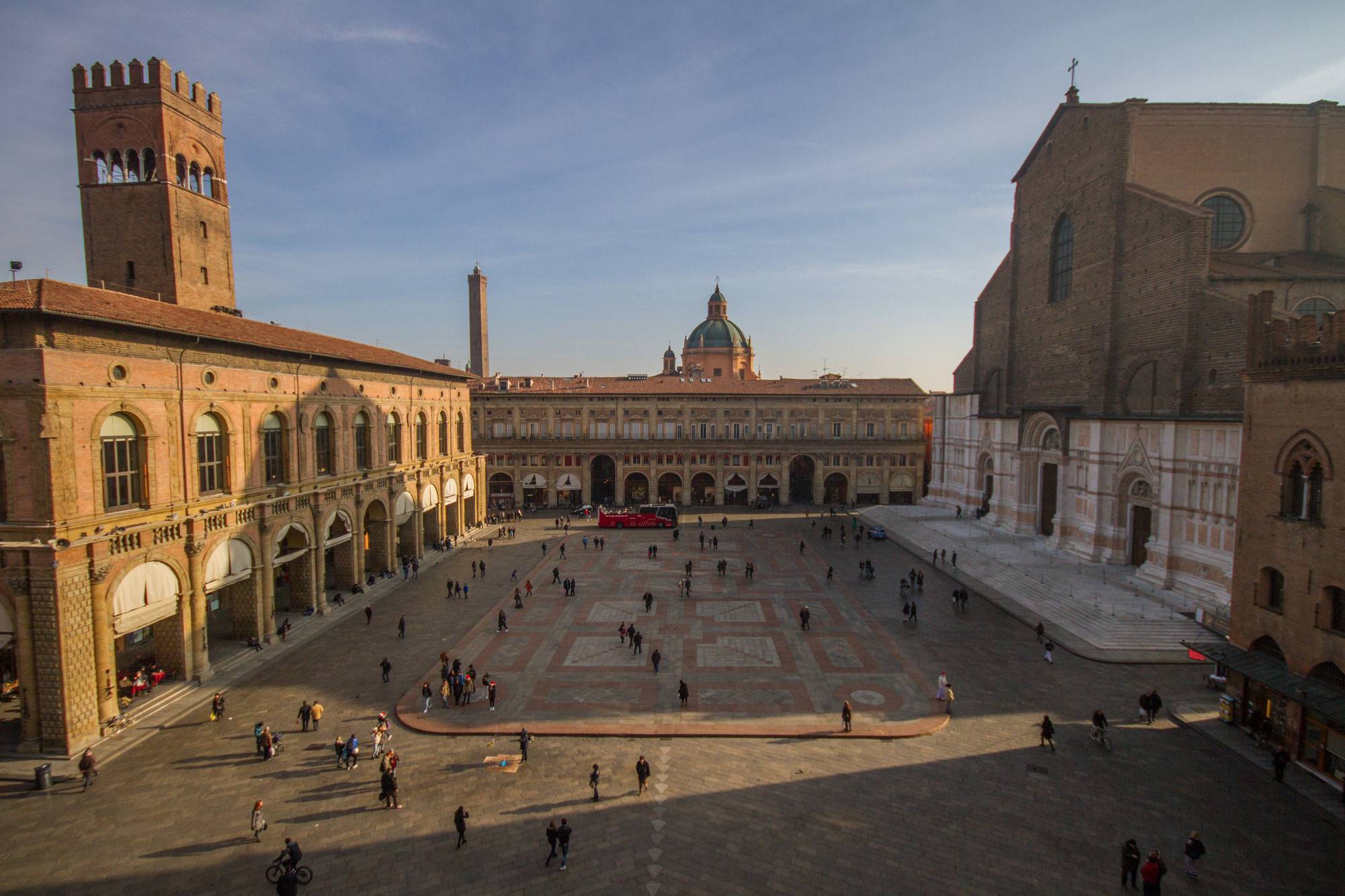
After Sala Borsa, just a few metres away, you’ll find yourself in Piazza Maggiore, where geology manifests itself in everything from sediments to architecture. Materials such as terracotta and brick, made from clay, lend their characteristic red colour to Bologna’s buildings, porticoes and towers.
A few words on Bologna’s clay:
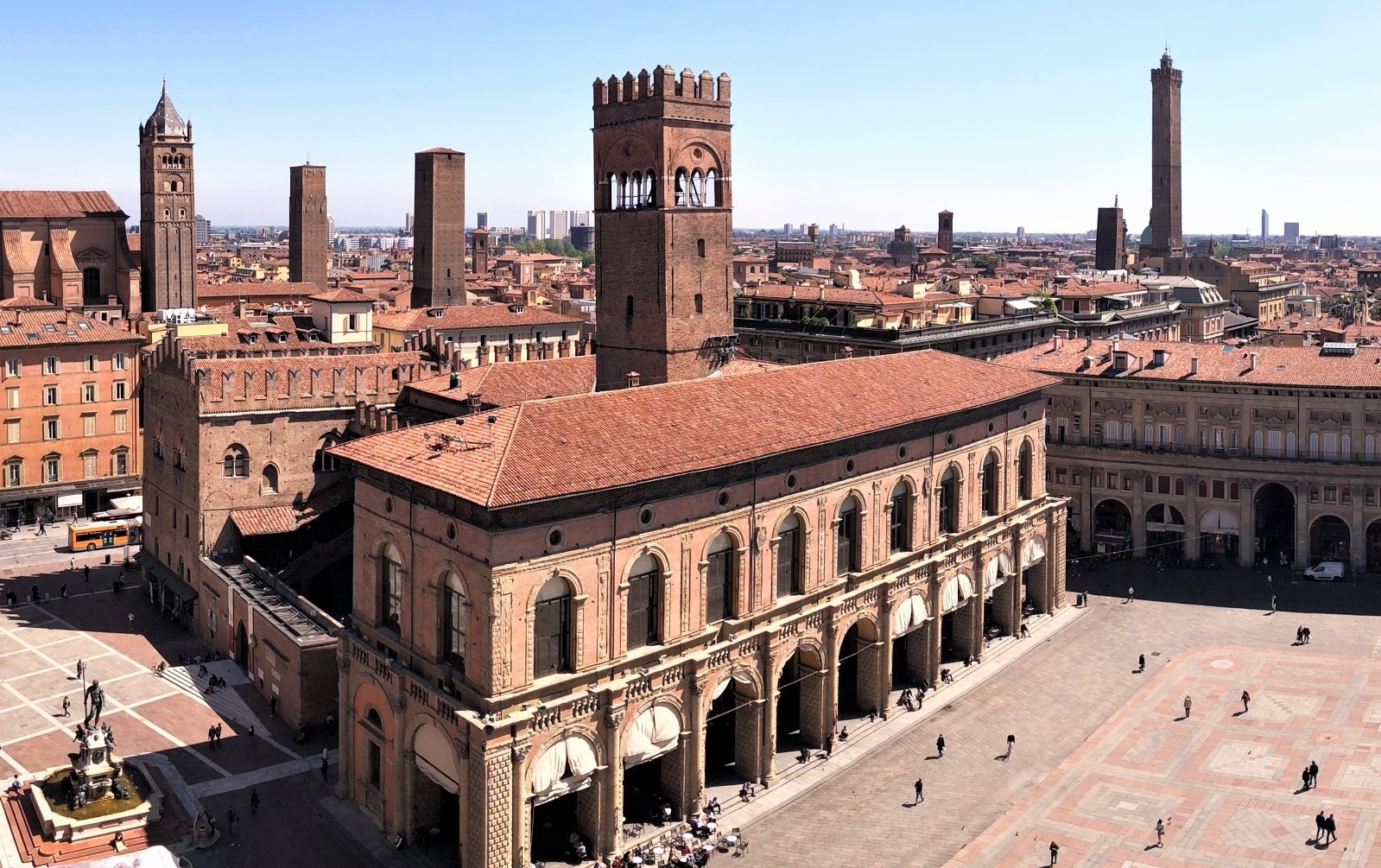
Stop off in Piazza Maggiore and look around: red clay materials can be seen in Palazzo Re Enzo, Palazzo del Podestà and Palazzo d’Accursio, inside which there is a historical detail linking Bologna to the seismic activity of the Apennines. It is the fresco of the Madonna del Terremoto, housed in the Sala d’Ercole of Palazzo d’Accursio, which commemorates the earthquake of 1505.
A view of the historic buildings of Piazza Maggiore from the Clock Tower
From Piazza Maggiore, you can continue on to the Civic Archaeological Museum, at 2 Via dell’Archiginnasio. In the sections dedicated to the Etruscans, the people of Bologna and the Romans, the funerary stelae help visitors to understand and explore another material – sandstone – which was used and worked in the city.
A few words on Bolognese sandstone, a rock material comprising two types and varieties:
Returning to the itinerary, you reach the Complex of the Seven Churches in Piazza Santo Stefano. On the façade of the Church of Saints Vitale and Agricola, there are fragments of green and red Egyptian porphyry. Throughout the complex, one also finds terracotta, sandstone and selenite, often the result of reuse and restoration work.
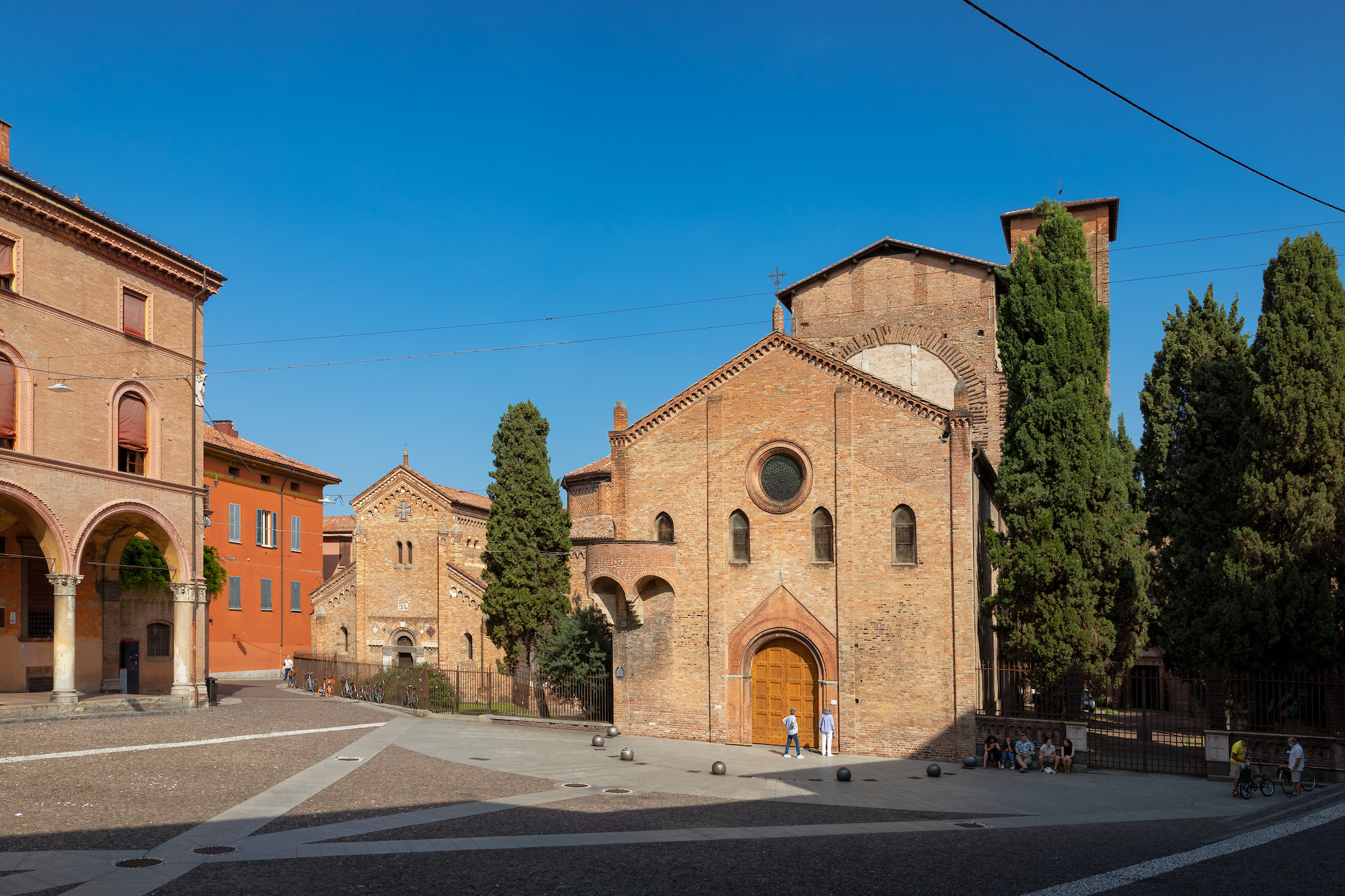
Complex of the Seven Churches in Piazza Santo Stefano
Selenite is one of the key terms for understanding Bologna’s geology. It is a variety of gypsum with milky sheens, reminiscent of the Moon’s luminous reflections, from which it derives its name of Greek origin, "Selene". According to an ancient popular belief, this stone contains an image of the moon, and its own luminosity changes in line with the moon’s waxing and waning.
It can be seen in the Garisenda Tower, in the bases of some towers and in the remains of the ancient city walls. In Via San Vitale, the Torresotto (or "serraglio") of San Vitale retains traces of the Cerchia dei Torresotti, built with terracotta and blocks of selenite.
Another worthwhile stop is in the courtyard of Casa Conoscenti, at 6 Via Manzoni, where in 1976 several blocks of selenite were discovered in the upper part of the ancient wall, known as the Cerchia di Selenite. It
is a small, almost hidden passage, but very obvious to anyone looking for rocks, and here one finds the only intact remains of the wall.
From here, the route can head back towards Strada Maggiore. At Palazzo Davia Bargellini, the sandstone Atlantean figures on the main façade face the street; a little further on, the portico of Santa Maria dei Servi features Istrian limestone, which reached Bologna in historical times partly thanks to the waterways of the Adriatic and the plain.
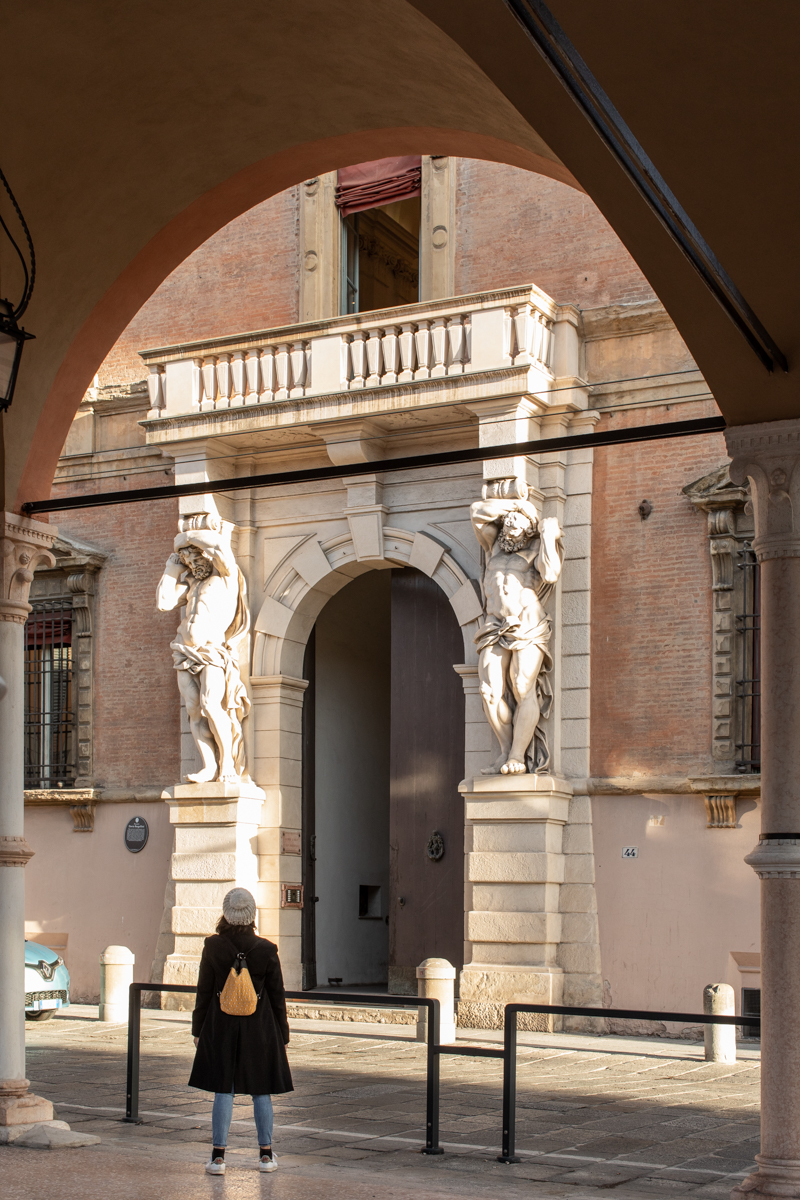
The university area is the most scientific part of the
route. In Via Zamboni, there are two places that should feature on any
geological tour of Bologna:
Outside the historic centre, at Viale della Fiera 8, the Sandra Forni Geological Garden Museum houses rocks, minerals and fossils linked to the region’s geological heritage. Admission to the indoor sections is free, subject to ID checks; the outdoor section remains freely accessible.
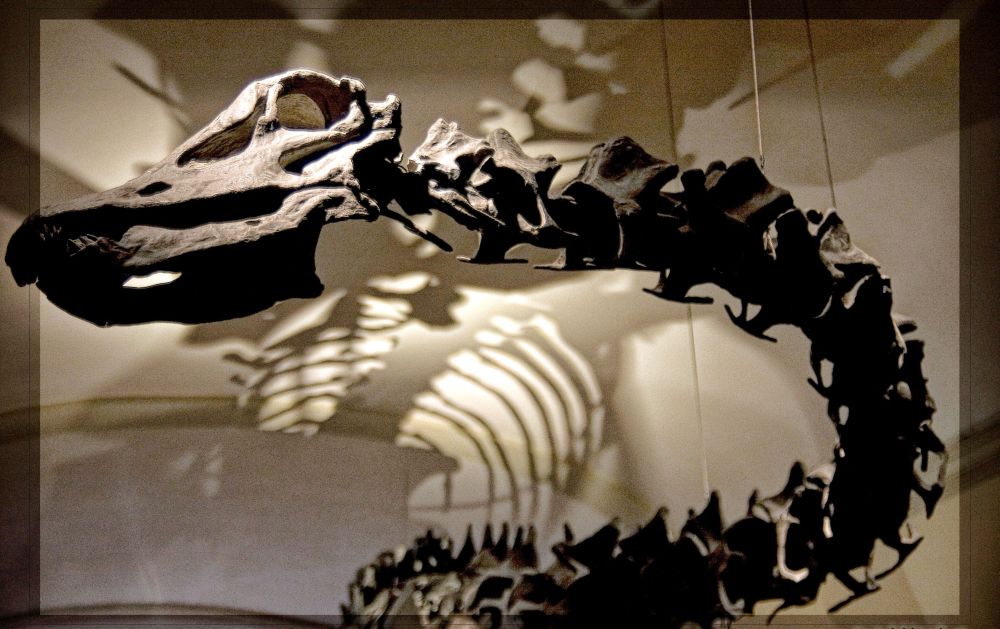
Diplodocus, ‘Giovanni Capellini Museum’ Geology Collection
To see Bologna’s geology away from the
city’s buildings, you need to head south-east. An unmissable stop is the Bolognese Gypsum Formations and Calanchi dell’Abbadessa Park, which stretches between Bologna, San Lazzaro di Savena, Ozzano
dell’Emilia and Pianoro.
Here, gypsum outcrops, caves, sinkholes and badlands can be found, and there are over 130 caves formed around these gypsum outcrops. Walking or cycling through this park is a rare privilege to which you should devote at least half a day’s visit.
The most recommended stops are:
But be careful! Always check the condition of the paths and the access rules, especially for caves and karst areas.
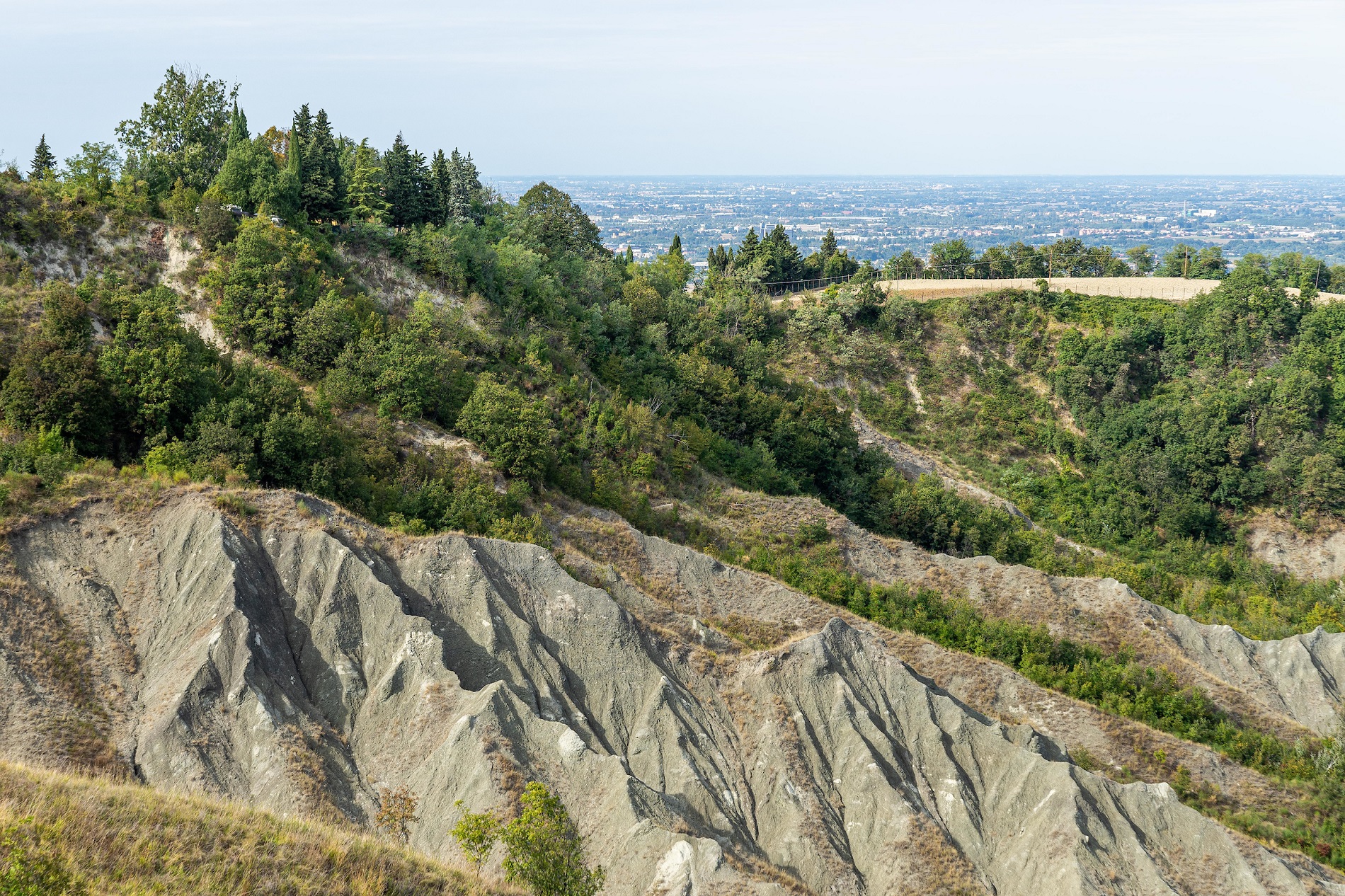
Chalk formations in the Parco dei Gessi Bolognesi and the Calanchi dell’Abbadessa
In the Gorgognano - Pianoro area of Val di Zena, in the province of Bologna, a farmer discovered the remains of a Balaenoptera austrostrata in 1965. The specimen, dating from between 2 and 5 million years ago, was 9 metres long and probably ended up at that spot after becoming stranded on the shoreline of what was then the Intrappennine Basin.
Today, to commemorate this fascinating archaeological and geological discovery, a posthumous reconstruction of the whale’s skeleton – created by students at the Academy of Fine Arts in Bologna – stands at the very spot where it was found. The fossil remains, however, are on display at the ‘Giovanni Capellini’ Geological Museum in Bologna.
In the immediate vicinity, a visit to the Museum of Botroids is also well worth it; it houses a collection of anthropomorphic sandstone boulders collected by the speleologist Luigi Fantini in the early 1900s along the River Zena.

Whale Monument, Pianoro, Val di Zena
An alternative option to this itinerary is to start the Via dei Gessi e dei Calanchi, a 102-kilometre route linking Bologna to Brisighella and Faenza. It is suitable for those who wish to move from an urban itinerary to a multi-day trek through the gypsum formations, ridges, valleys and villages of the Apennines.
Another possible stop, to be added to or substituted for those on this itinerary, is the “Elsa Silvestri” Civic Archaeological and Palaeoenvironmental Museum in Budrio, which tells the story
of the Bologna plain from the Palaeolithic to the Middle Ages and is open on the third
Sunday of the month or by appointment.
Check the official website for updates and opening times.
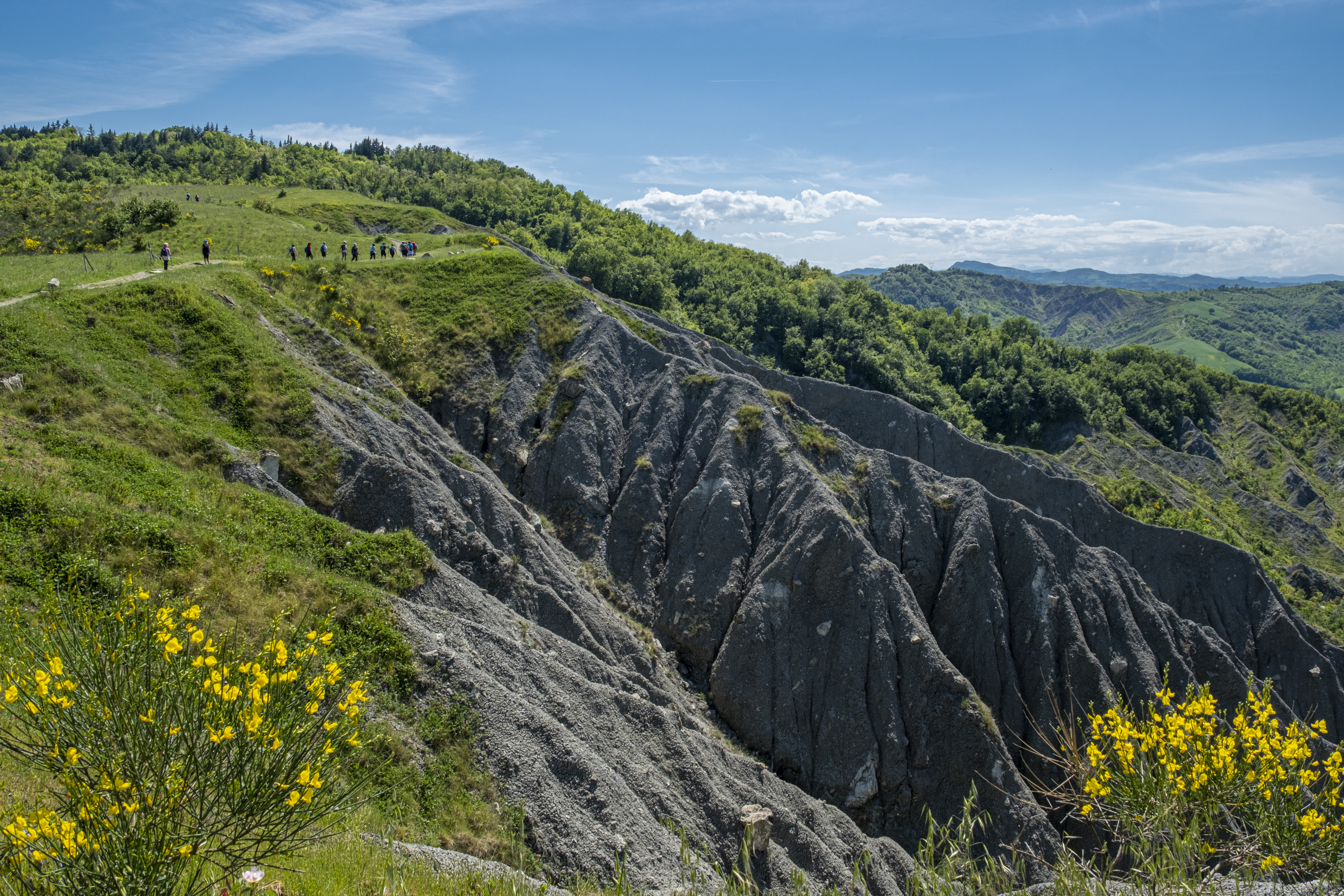
Via dei Gessi e dei Calanchi
Anyone with a passion for geology knows that the sole common thread running through their exploration of this subject is geosites or geotypes.
Geosites are simply geological sites: a mountain range, a hill or a coastline – when well-preserved, they form spectacular landscapes and provide essential information for understanding the Earth, its formation and its evolution.
Together, these geosites form the natural heritage of a region, which must be protected and promoted because they tell the story of our planet.
TIPS: Remember that the Emilia-Romagna Region provides fact sheets on regional geosites, featuring descriptions, maps and scientific content for further reading.
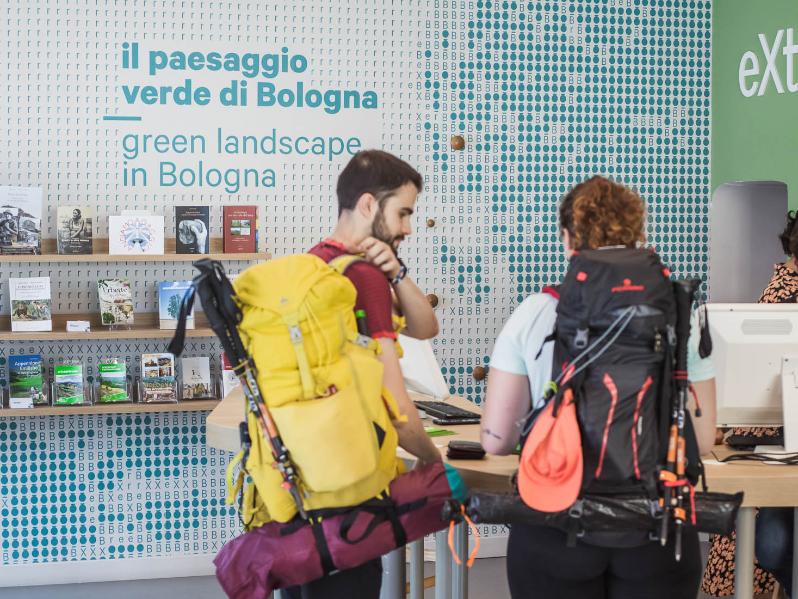
Visit eXtraBO, the Outdoor Infopoint for Bologna and the surrounding area